
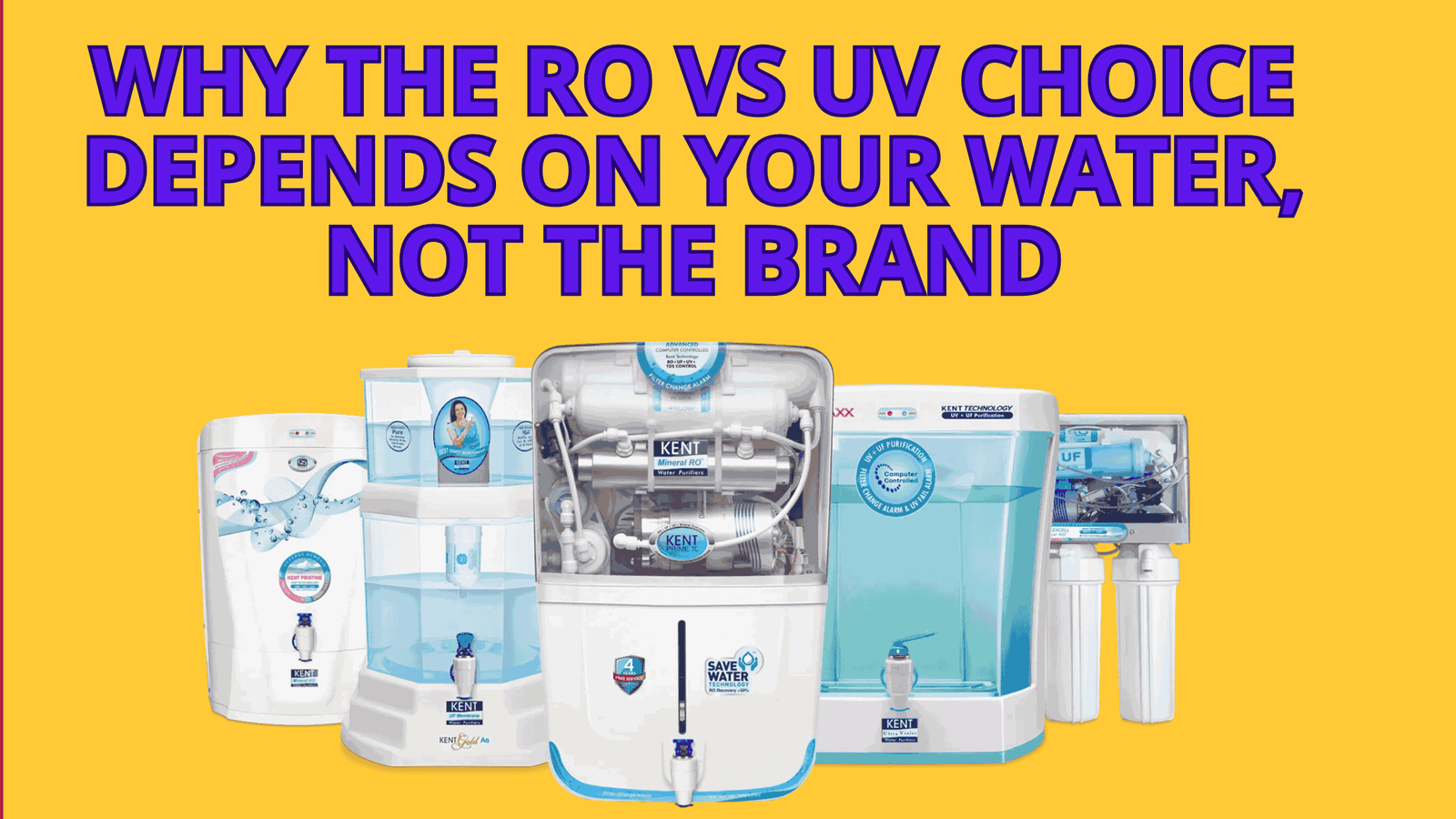
Buying a water purifier in India feels harder than it should. Every brand promises “pure water,” but the real question is simpler: does your water even need the technology you’re paying for?RO vs UV Guide Choosing between an RO vs UV water purifier isn’t about which is “better” — it’s about which matches the water coming out of your tap.
Pick the wrong one and you’re either wasting money on unnecessary filtration or drinking water that still contains dissolved impurities. This guide gives you a quick, practical framework to decide based on your actual water quality — not brand marketing.
Why the RO vs UV Choice Depends on Your Water, Not the Brand
Most buyers walk into a store or open an Amazon page and start comparing brands — Kent, Aquaguard, Urban Company, Atomberg. But brand is the last decision, not the first.
The first decision is filtration technology. RO (Reverse Osmosis), UV (Ultraviolet), UF (Ultrafiltration), and newer Nano filtration each solve different problems. Your water source — municipal supply, borewell, or tanker — determines which one you need.
A purifier that’s perfect for your neighbour’s flat could be completely wrong for yours, even in the same building, if the water sources differ. Municipal flats in metros like Mumbai or Pune often receive low-TDS treated water, while homes on borewell supply in the same city face an entirely different water profile.
What Is TDS and Why It Decides Everything
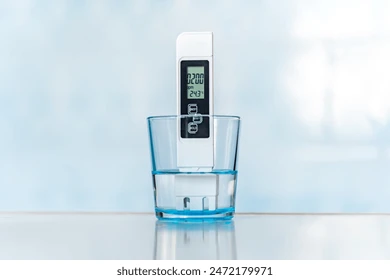
TDS stands for Total Dissolved Solids — the minerals, salts, and metals dissolved in your water, measured in parts per million (ppm). It’s the single most important number in your buying decision.
Why? Because only RO technology can reduce TDS. UV kills bacteria and viruses but changes nothing about dissolved solids. If your water has high TDS and you buy a UV purifier, you’ve solved a problem you didn’t have.
How to Test Your Water’s TDS Level
You can check your water’s TDS in under five minutes:
- Buy a TDS meter (available online for ₹200–400) and dip it in a glass of tap water
- Use a free water testing service offered by many purifier brands during demos
- Check your municipal corporation’s water quality report if you’re on city supply
Test at the source you actually drink from. If your building receives both municipal and tanker water, test each supply separately — the readings can differ dramatically.
Safe TDS Range for Drinking Water
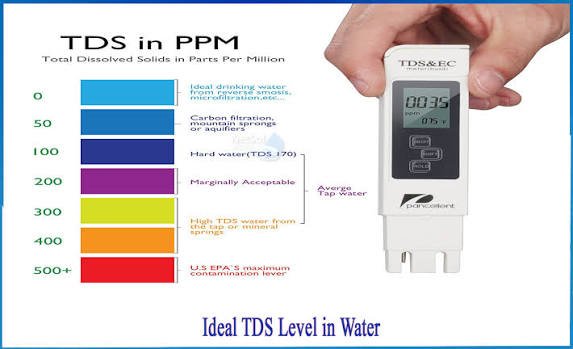
As a working reference, the Bureau of Indian Standards (BIS 10500) recommends drinking water TDS up to 500 ppm, with 300 ppm considered ideal for taste. The WHO notes that water below 300 ppm is generally acceptable.
Extremely low TDS (below 50 ppm) isn’t great either — the water tastes flat and lacks essential minerals. This is why blindly choosing RO for low-TDS municipal water can actually harm water quality.
RO vs UV vs Nano — Which Works for Your TDS Range
Here’s the practical decision framework:
| Your TDS Level | Best Technology | Why |
|---|---|---|
| Below 200 ppm | UV + UF | Water is already low in dissolved solids; you mainly need germ protection |
| 200–500 ppm | Nano filtration or RO with TDS controller | Middle zone; Nano preserves minerals, RO needs mineral correction |
| Above 500 ppm | RO (mandatory) | Only RO can bring dissolved solids down to safe levels |
Below 200 ppm: UV/UF Is Enough
If you’re on treated municipal water with low TDS, a UV purifier with a sediment and carbon filter handles bacteria, viruses, and bad taste. You save money upfront and pay far less in maintenance — UV lamps are cheap compared to RO membranes.
200–500 ppm: The Grey Zone
This is where most urban homes sit. You can go either way, but consider Nano filtration (a newer middle-ground technology) or an RO unit with a mineraliser/TDS controller so essential calcium and magnesium aren’t stripped out along with the contaminants.
Above 500 ppm: RO Is Mandatory
Borewell and tanker water in many Indian cities regularly exceeds 500 ppm — sometimes crossing 1,000. Here, RO isn’t optional. Pair it with UV (most modern RO units include it) so you get both dissolved-solid reduction and microbial protection.
Don’t Forget Heavy Metals in Groundwater
TDS meters don’t detect arsenic, lead, or fluoride contamination — and these are real risks in groundwater across several Indian states. If you use borewell water, check your district’s groundwater quality data (the Central Ground Water Board publishes reports) before finalising your purifier.
For heavy-metal-affected areas, RO with appropriate post-filtration is the only reliable home solution. A lab test of your borewell water (₹1,000–2,000 at accredited labs) is worth the cost before investing in a purifier.
Hidden Costs — Filter Life and Maintenance
The sticker price is only half the story. Traditional RO purifiers need filter and membrane replacements every 6–12 months, and annual maintenance contracts (AMCs) often cost ₹3,000–5,000 per year — sometimes exceeding the purifier’s price within three years.
Newer models with extended 2-year filter life are changing this equation. When comparing models, calculate the 5-year total cost: purchase price plus filter replacements plus AMC. A ₹15,000 purifier with cheap maintenance beats a ₹12,000 one with expensive filters.
Also watch for a common trap: some brands lock you into proprietary filters that only their service network supplies. Before buying, search for third-party replacement filter availability — it tells you how much pricing power the brand holds over you for the next decade.
Common Mistakes Buyers Make
Even well-researched buyers slip up on these:
- Buying RO by default. Sales teams push RO because it’s the higher-ticket item, even when TDS is under 200
- Ignoring storage tank hygiene. A great purifier with a dirty tank re-contaminates your water
- Trusting “8-stage” marketing. More stages isn’t automatically better — what matters is whether the right stages (sediment, carbon, RO/UV) are present for your water
- Skipping the electricity check. UV and RO purifiers need power; UV without electricity gives zero protection
Key Features to Check Before Buying
Beyond technology, these details separate good purifiers from frustrating ones:
- Tank material: Food-grade plastic or stainless steel storage matters, especially in warm climates
- Hot water dispensing: Useful if your household drinks warm water regularly
- App connectivity: Genuinely useful for filter-life tracking, not just a gimmick
- “Zero water wastage” claims: RO inherently wastes water; read what the claim actually means — usually the rejected water is redirected for reuse, not eliminated
Quick Decision Checklist
Before you buy, run through these five steps:
- Test your water’s TDS (₹200 meter, five minutes)
- Confirm your water source — municipal, borewell, or mixed
- Match technology to TDS: UV below 200, Nano/RO in the middle, RO above 500
- Check groundwater quality reports if you’re on borewell water
- Compare 5-year total cost, not just purchase price
Get these right and you’ll buy once — and buy correctly.
Frequently Asked Questions
Is RO water safe to drink daily?
Yes, as long as the purifier includes a mineraliser or TDS controller. Pure RO strips out beneficial minerals along with contaminants, so modern RO units add calcium and magnesium back. Without remineralisation, long-term consumption of very low-mineral water isn’t ideal.
Can I use a UV purifier for borewell water?
Not recommended. Borewell water typically has high TDS and may contain dissolved heavy metals that UV can’t remove. UV only disinfects — it kills microorganisms but leaves dissolved solids untouched.
How often should RO filters be replaced?
Standard RO filters and membranes need replacement every 6–12 months depending on input water quality and usage. Newer long-life models stretch this to around 2 years. Higher incoming TDS shortens filter life significantly.
Which is cheaper to maintain — RO or UV?
UV purifiers cost considerably less to maintain. UV lamp and sediment filter replacements run a few hundred rupees annually, while RO membranes plus multi-stage filters typically cost ₹2,000–5,000 per year.