

If you are looking for a powerful Sujata mixer grinder in 2026, you may be wondering whether the brand is still worth choosing when the market is full of newer mixer grinders with modern designs, digital controls, quieter motors, and additional attachments.
The short answer is yes, Sujata mixer grinders are still a very good choice in 2026—especially if grinding power, durability, and heavy-duty everyday performance matter more to you than flashy features.
Sujata has traditionally focused on relatively powerful motors and practical designs suited to Indian cooking. Its current mixer grinder range includes 900W and 1000W models with double-ball-bearing motors. Depending on the model, buyers can choose different jar configurations for chutneys, wet grinding, dry spices, batters, blending, and other kitchen tasks.
But that does not automatically make every Sujata model the right choice for every kitchen.
This detailed Sujata mixer grinder review for 2026 examines performance, motor power, durability, jars, noise, ease of use, maintenance, advantages, disadvantages, and the type of buyer who will benefit most from choosing one.
Quick Verdict: Is Sujata Mixer Grinder Good?
Yes. A Sujata mixer grinder is particularly good for households that regularly grind masalas, chutneys, wet batters, spices, pulses, pastes, and other demanding ingredients.
The company’s current lineup emphasizes high-powered 900W and 1000W motors instead of the 500W–750W motors commonly found in lighter-duty machines. Current models such as the Dynamix use a double-ball-bearing motor, while Sujata’s newer MG01, MG02, and MG03 range moves up to 1000W.
For buyers whose priority is simply occasional blending or light chutney preparation, this level of power may be unnecessary. But for a family that cooks regularly and expects one appliance to handle both everyday and tougher grinding jobs, Sujata remains highly competitive.
| Area | Our 2026 Assessment |
|---|---|
| Grinding power | Excellent |
| Heavy-duty use | Excellent |
| Wet and dry grinding | Very good |
| Motor construction | Very good |
| Jar options | Very good |
| Ease of use | Good |
| Noise | Moderate to high depending on task/model |
| Modern styling | Functional rather than feature-heavy |
| Suitability for Indian cooking | Excellent |
| Overall verdict | Highly recommended for performance-focused buyers |
Why Is Sujata Mixer Grinder Popular?
The biggest reason is straightforward: Sujata focuses heavily on the motor and grinding mechanism.
While many modern kitchen appliances compete through touch controls, premium finishes, preset programs, or smart features, Sujata’s mixer grinder range remains comparatively performance-oriented.
Its official 2026 lineup lists MG01, MG02 and MG03 as 1000W options, while Dynamix and Supermix use 900W double-ball-bearing motors. The models are positioned for tasks ranging from everyday cooking to heavy-duty grinding and large-family use.
That makes the brand particularly relevant in an Indian kitchen, where a mixer grinder may need to handle significantly more than smoothies.
One day you may be preparing coconut chutney. The next day it could be soaked dal for dosa, dry red chillies, garam masala, ginger-garlic paste, or a thick gravy.
That variety places considerable demands on the motor, blade assembly, coupler, and jars.
Sujata Mixer Grinder Motor Power: 900W vs 1000W
Motor performance is one of Sujata’s strongest selling points.
The current range broadly falls into two groups.
| Sujata Model | Motor Power | Motor Type | Main Use |
|---|---|---|---|
| MG01 | 1000W | Double ball bearing | Precision and heavy grinding |
| MG02 | 1000W | Double ball bearing | Heavy-duty grinding |
| MG03 | 1000W | Double ball bearing | Multi-purpose family use |
| Dynamix | 900W | Double ball bearing | Heavy daily grinding |
| Supermix | 900W | Double ball bearing | Everyday use/value |
Sujata’s official comparison positions its 1000W MG series for heavy grinding, tougher ingredients and larger households, while the 900W Dynamix and Supermix are intended for regular Indian cooking and daily grinding.
Is a 900W Sujata Mixer Grinder Powerful Enough?
For most households, yes.
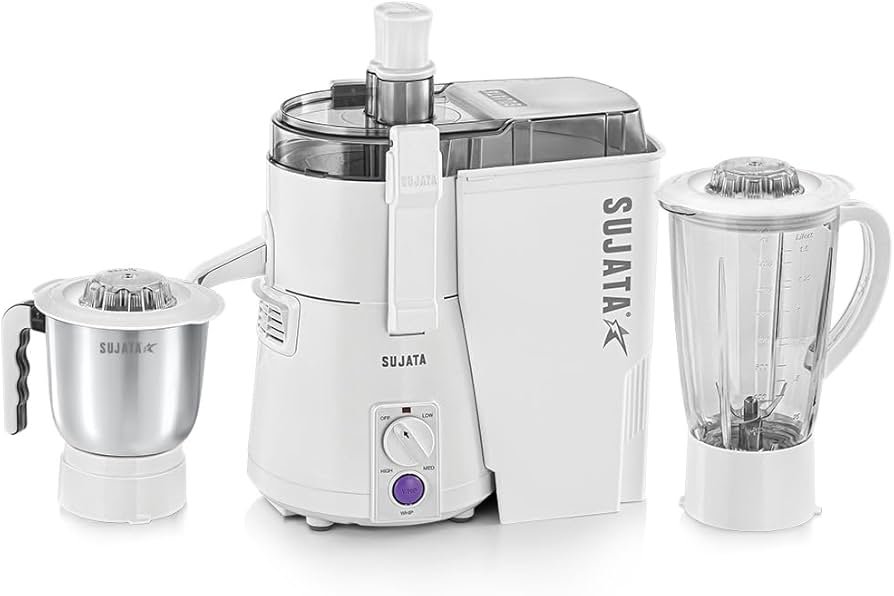
The Sujata Dynamix, for example, has a 900W universal double-ball-bearing motor with an approximately 22,000 RPM maximum no-load speed. Its official specifications give it a 90-minute rating.
That makes it suitable for much more than basic blending.
Its 1.5-litre dome blender jar is intended for jobs such as dosa batter and gravies, while the smaller stainless-steel jars are designed for spices, chutneys and similar preparations.
When Does a 1000W Model Make More Sense?
Consider a 1000W Sujata mixer grinder if your household regularly processes hard ingredients, prepares larger quantities, or simply wants additional power headroom.
The MG01, for example, uses a 1000W double-ball-bearing motor, has a rated operating time of 90 minutes, and a maximum no-load motor speed listed at 25,000 RPM on its individual product page. It comes with a 1.75-litre transparent blender jar, 1-litre grinding jar, and 500ml chutney jar.
For normal household chutneys or occasional smoothies, however, buying additional wattage simply for the bigger number is not necessary.
How Good Is a Sujata Mixer Grinder for Indian Cooking?
This is where Sujata makes the strongest case for itself.
A good Indian kitchen mixer with grinder functions needs to work with both wet and dry ingredients. It should be able to process relatively small batches of chutney as well as larger quantities of batter or gravy.
Sujata’s current jar configurations are designed around those needs.
The brand lists approximately 0.5-litre jars for chutneys and smaller dry-grinding jobs, 1-litre jars for grinding and pastes, and larger 1.5-litre or 1.75-litre containers for blending and batters depending on the model. The MG03 also includes additional accessories, including a coconut milk extractor.
Dry Grinding
Hard spices are a useful test of any grinder mixer because they place greater demand on the blades and motor than soft fruits.
Sujata specifically positions its machines for ingredients such as dry chillies, peppercorns, cumin, turmeric and other spices. The Dynamix’s 1-litre stainless-steel jar, for example, is designed for dry grinding spices, pulses and cereals.
Wet Grinding
For chutneys, pastes, gravies and marinades, jar geometry and blade movement matter alongside raw motor power.
Sujata offers dedicated smaller jars for items such as coconut chutney, mint chutney and ginger-garlic paste, while the larger jars are more suitable for wet mixtures and batters.
Dosa and Idli Batter
A powerful mixer grinder is particularly useful if dosa or idli batter is prepared frequently.
Sujata’s Dynamix includes a large dome blender jar designed for processing soaked rice and urad dal, among other ingredients. The manufacturer also specifically identifies its mixer grinders as suitable for batter preparation.
If large batches are prepared regularly, however, a dedicated wet grinder can still be more convenient than any conventional mixer grinder.
Are Sujata Mixer Grinders Durable?
Durability is one of the main reasons buyers continue to consider the brand.
Current Sujata machines use double-ball-bearing motors across the highlighted range. The Dynamix and MG01 product pages also specify 100% copper motor winding.
The Dynamix uses metal couplers on its jars, while the MG01 uses high-tensile stainless-steel cutter blades and metal coupler assemblies.
These are meaningful construction details for a kitchen appliance that may be started and stopped hundreds of times over its service life.
Recent customer feedback also continues to mention strong performance and sturdy construction, although user reviews should be viewed as anecdotal rather than controlled durability testing. Some 2026 buyers specifically praise Sujata’s power and build quality, while others note that noise can be noticeable.
Does Sujata Mixer Grinder Make a Lot of Noise?
This is one area where expectations should be realistic.
A powerful high-speed mixer grinder is rarely silent, particularly when processing hard ingredients.
Recent customer reviews are mixed: some describe the machines as relatively quiet compared with their previous mixers, while others specifically identify noise as a disadvantage.
In practical terms, buyers should expect motor and ingredient noise, particularly during dry grinding.
If near-silent operation is your number-one requirement, you should compare Sujata with newer low-noise or BLDC alternatives before purchasing rather than choosing purely on grinding power.
Sujata Mixer Grinder Jars and Usability
Jar selection differs significantly by model, so buyers should not choose only by motor wattage.
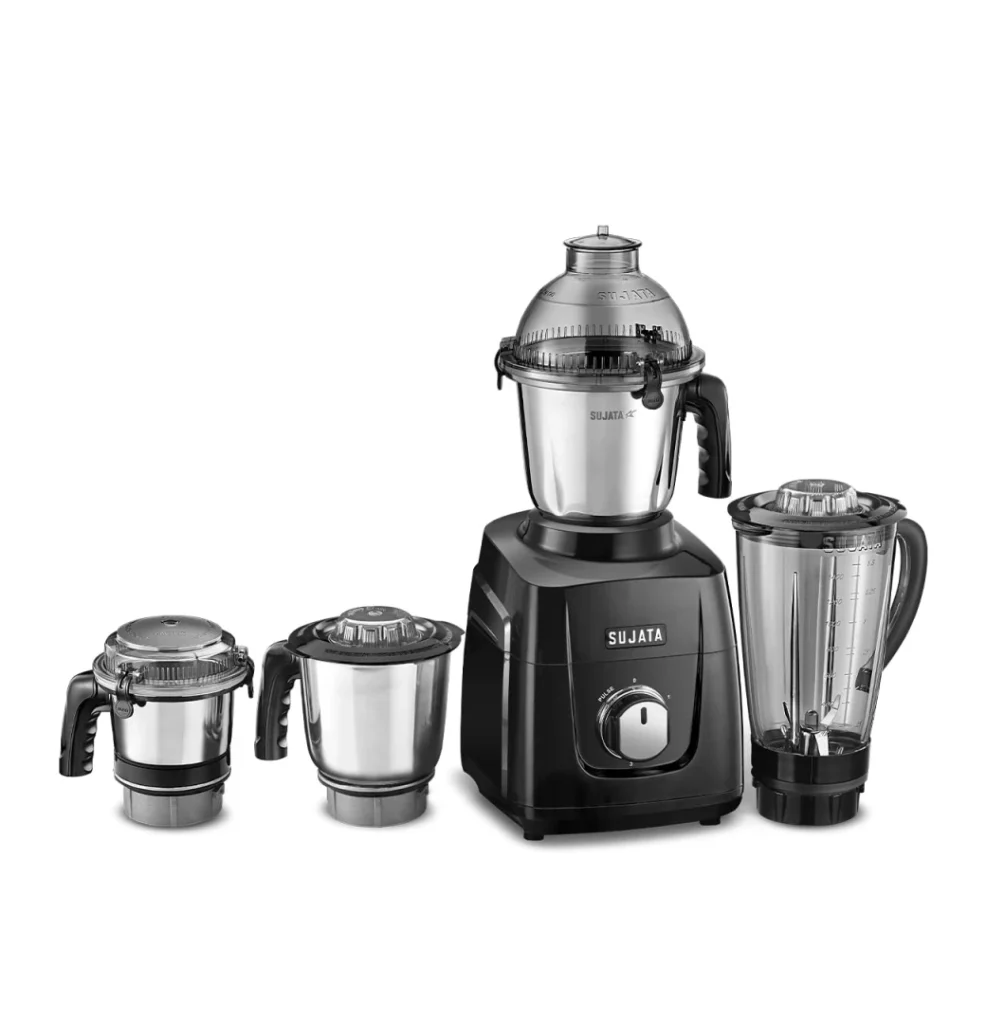
The MG01 combines a large transparent blending jar with two stainless-steel grinding jars. MG02 and Dynamix emphasize stainless-steel jars, while MG03 provides four jars plus a coconut milk extractor. Supermix offers a combination of stainless-steel and transparent jars.
For most households, three useful jars are more valuable than a large collection of attachments that remain unused.
Before choosing your Sujata mixer grinder, think about what you actually prepare every week.
A household making chutney, spice powders and smoothies has different requirements from one frequently preparing dosa batter, coconut milk and large quantities of masala paste.
Sujata Mixer Grinder Advantages and Disadvantages
The strongest advantage is performance. The 900W–1000W current range gives Sujata considerable power for demanding kitchen preparation, and double-ball-bearing motors are used throughout its main lineup. Models such as Dynamix and MG01 also have 90-minute ratings, which helps explain the brand’s heavy-duty positioning.
Jar choices are another advantage. Buyers can select configurations focused on stainless-steel grinding jars, transparent blending jars, or additional attachments.
The disadvantages are more subjective. Sujata’s approach is generally functional rather than gadget-heavy, so buyers seeking touchscreen panels, numerous presets or highly contemporary designs may find competing products more attractive.
Noise may also be noticeable, particularly during demanding grinding jobs. And because Sujata typically competes on motor strength and durability rather than entry-level pricing, it may be unnecessary for someone who only needs occasional light mixing.
Which Sujata Mixer Grinder Is Best in 2026?
There is no single model that is best for every buyer.
Sujata Dynamix – Best for Heavy Daily Grinding
The Dynamix remains a strong choice for traditional Indian cooking. Its 900W double-ball-bearing motor, 22,000 RPM maximum no-load speed, 90-minute rating and three grinding jars make it especially well suited to households preparing spices, chutneys, wet batters and masalas regularly.
Sujata MG01 – Best for Buyers Wanting 1000W Power
The MG01 increases power to 1000W and pairs it with a large 1.75-litre transparent blender jar plus 1-litre and 500ml stainless-steel jars. Its individual product page specifies a maximum no-load speed of 25,000 RPM and a 90-minute rating.
Sujata MG02 – Best for Stainless-Steel Jar Preference
Sujata positions the MG02 as a heavy-duty 1000W option using three stainless-steel jars with aluminium sockets.
Sujata MG03 – Best for Versatility
MG03 is the most attachment-rich option among the currently highlighted models. It combines a 1000W motor with four jars and a coconut milk extractor, making it attractive to households that genuinely use a wider variety of food-processing functions.
Sujata Supermix – Best for Simpler Everyday Needs
Supermix uses a 900W double-ball-bearing motor and is positioned by Sujata as its more affordable everyday mixer grinder option.
Who Should Buy a Sujata Mixer Grinder?
A Sujata mixer grinder makes the most sense for someone who cooks frequently, grinds hard spices, prepares Indian chutneys and pastes, makes wet batters, values motor strength, and prefers functional durability over unnecessary electronic features.
It is particularly attractive for medium-to-large households where the appliance is used every day rather than once or twice a week.
Who Might Prefer Another Mixer Grinder?
You may want to compare alternatives if your biggest priorities are extremely quiet operation, ultra-compact dimensions, advanced digital controls, app connectivity, numerous automatic presets, or the lowest possible purchase price.
Likewise, a 900W or 1000W machine may be excessive if you mainly use your appliance for occasional milkshakes and soft ingredients.
Buying the most powerful motor available does not automatically produce the best ownership experience. The right mixer grinder is the one whose power, jars, size, noise level and functions match your cooking routine.
Is Sujata Mixer Grinder Worth Buying in 2026?
For the right buyer, yes—a Sujata mixer grinder is still worth buying in 2026.
Its biggest strengths remain closely aligned with what matters in demanding Indian cooking: powerful 900W–1000W motors, double-ball-bearing construction, useful jar configurations, high-speed grinding and models designed for extended heavy-duty operation.
Sujata may not always offer the flashiest control panel or the most futuristic-looking appliance. But if you care more about how effectively your mixer processes masalas, chutneys, batters and tough ingredients, its performance-first approach remains relevant.
The most important decision is therefore not simply, “Is Sujata good?”
It is which Sujata model matches your cooking habits?
For heavy everyday grinding, Dynamix is an obvious model to compare. For more power, look toward the 1000W MG series. For greater versatility, MG03 deserves consideration, while buyers with simpler requirements can evaluate Supermix.
That is ultimately why Sujata continues to stand out in 2026: instead of trying to turn a kitchen grinder into a smart gadget, it continues to focus primarily on doing the grinding job well.
Frequently Asked Questions
Is Sujata mixer grinder good for daily use?
Yes. Current Sujata models use 900W or 1000W double-ball-bearing motors and are specifically positioned for regular Indian cooking. Dynamix, for example, carries a 90-minute rating and is designed for demanding wet and dry grinding.
Which Sujata mixer grinder is best for home use?
It depends on the household. Dynamix is a strong option for heavy everyday grinding, while the MG01, MG02 and MG03 offer 1000W motors for buyers wanting additional power. MG03 is particularly suitable when extra jars and a coconut milk extractor are useful.
Is a 900W Sujata mixer grinder enough?
For most normal Indian household grinding, yes. Sujata itself positions its 900W Dynamix and Supermix models for regular cooking and daily grinding, while its 1000W range is targeted more toward heavier loads, large families and tougher ingredients.
Can Sujata mixer grinder make dosa batter?
Yes. The Dynamix includes a 1.5-litre dome blender jar designed for wet grinding tasks that include rice and urad dal for dosa batter.
Is Sujata mixer grinder noisy?
It can be. Customer experiences vary, with some recent reviews describing acceptable noise and others considering it relatively noisy. Because these are powerful high-speed grinders, buyers prioritizing very quiet operation should compare noise performance carefully before purchasing.
Is a 1000W mixer grinder better than a 750W mixer grinder?
A 1000W motor provides greater power headroom for tough ingredients and heavier grinding, but it is not automatically better for every user. If your daily cooking involves hard spices, batters and large batches, the extra power can be useful. For lighter preparation, a lower-powered machine may be sufficient.
have you checked? washing machine article