Your electricity bill jumps every summer, and someone always says “switch to a BLDC fan, it saves power.” That advice is true — but it’s incomplete. A BLDC ceiling fan buying guide should tell you not just that these fans save electricity, but which one to buy for your specific room, wiring, and budget. This guide covers exactly that, without pushing you toward a single “best” pick you haven’t verified yourself.
What Is a BLDC Fan, and Why Does It Cost More?
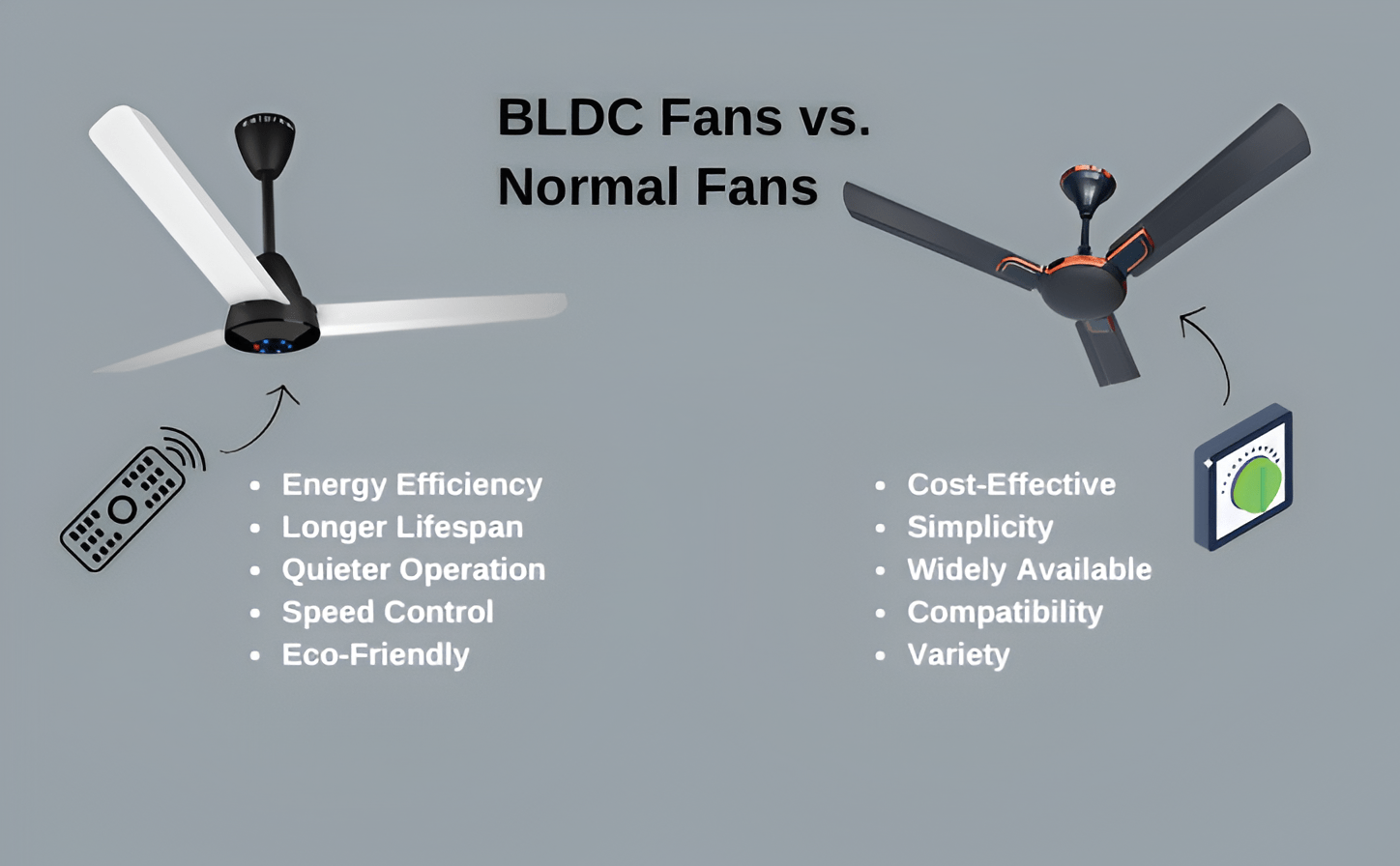
A BLDC fan uses a brushless direct-current motor instead of the induction motor found in traditional ceiling fans. Induction motors waste energy as heat while running; BLDC motors use permanent magnets and an electronic controller, so they draw far less power for the same airflow.
That efficiency is why a BLDC fan typically pulls 25–35 watts, compared to 70–80 watts for a standard fan. The trade-off is price: BLDC fans usually cost ₹500–₹3,000 more upfront than an equivalent regular fan.
How Much Can a BLDC Fan Really Save You?
The math depends on how many hours a day you run the fan and your local electricity rate. Here’s a rough comparison for one fan running 10 hours a day at ₹8/unit:
| Fan type | Power draw | Daily cost | Annual cost (10 hrs/day) |
|---|---|---|---|
| Regular induction fan | ~75W | ₹6 | ~₹2,190 |
| BLDC fan | ~30W | ₹2.40 | ~₹876 |
That’s roughly ₹1,300 saved per fan per year. If you’re replacing four fans across a home, the yearly saving adds up meaningfully — but the payback period still depends on how much extra you paid upfront and how many hours you actually run the fan daily. If your fans run 3–4 hours a day, the payback stretches out and the case weakens.
BLDC vs. Regular Induction Fan: Key Differences
| Factor | Induction fan | BLDC fan |
|---|---|---|
| Power consumption | 70–80W | 25–35W |
| Speed control | Mechanical regulator (steps) | Stepless, often remote/app |
| Capacitor | Yes (common failure point) | No |
| Inverter/battery backup runtime | Shorter | 2–3x longer on the same backup |
| Upfront price | Lower | Higher |
| Noise (at comparable air delivery) | Varies by build quality | Generally quieter |
Buying Factors That Actually Matter for Indian Homes
BEE Star Rating and Wattage
Check the BEE (Bureau of Energy Efficiency) star label on the box or listing, not just the word “BLDC” in the title — some budget models still land at 3-star efficiency rather than 5-star. A genuine 5-star BLDC fan should draw around 28–35 watts on high speed. You can cross-check current BEE star-rating criteria on the Bureau of Energy Efficiency’s official site before buying.
Air Delivery (CMM) vs. Room Size
Air delivery, measured in cubic metres per minute (CMM), tells you how much air the fan actually moves — wattage alone doesn’t. For a standard 10×12 ft bedroom, look for at least 210–220 CMM. Larger living rooms benefit from 230+ CMM or a second fan.
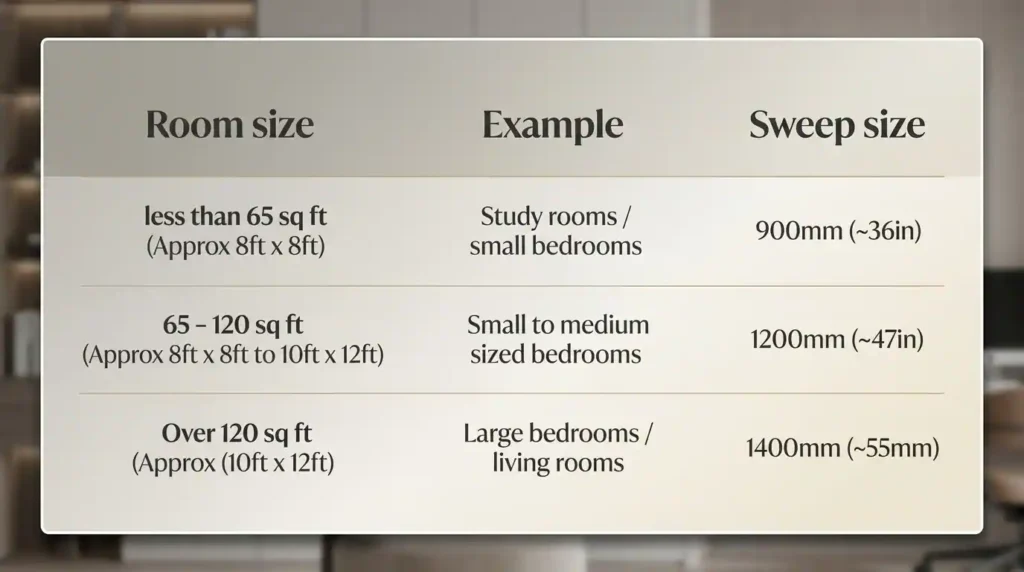
Sweep Size — 900mm, 1200mm, or 1400mm
- 900mm: Small rooms, kitchens, or low-ceiling spaces.
- 1200mm: The default for most Indian bedrooms and living rooms.
- 1400mm: Larger rooms where you want stronger air coverage without adding a second fan.
Remote/App Control vs. Your Existing Wall Regulator
Most BLDC fans ship with their own remote and drop the old mechanical regulator entirely. If your home has a wired-in wall regulator you want to keep using, check specifically for “dual control” or “regulator-compatible” in the listing — not every BLDC fan supports this, and it’s an easy detail to miss.
Inverter and Power-Cut Compatibility
Because BLDC fans draw so little power, they run 2–3 times longer on the same inverter or battery backup compared to induction fans. If your area gets frequent outages, this is one of the more concrete practical benefits, separate from the electricity-bill savings.
Noise Level and Warranty/Service Network
Cheaper BLDC fans from newer brands can be noisier at top speed than established brands, even with similar specs on paper. Also check the service network for the brand in your city or town — a 2–3 year warranty is only useful if a technician is actually reachable when something goes wrong.
Who Should Buy a BLDC Fan — and Who Can Skip It
Buy one if: you run fans 8+ hours a day, face frequent power cuts and rely on inverter backup, or are fitting out a new home where the price difference is easier to absorb upfront.
You can skip it if: you use fans only a few hours a day, you’re on a tight renovation budget, or your existing fans are working fine and don’t need replacing yet — the environmental and cost case is weaker at low usage.
Common Mistakes to Avoid
- Assuming “BLDC” alone means best efficiency. Always check the actual star rating and wattage.
- Ignoring regulator compatibility if you want to keep your existing wall switches.
- Buying sweep size by habit instead of matching it to the room.
- Skipping the service-network check for newer or lesser-known brands.
FAQs
Is a BLDC fan worth it for a rented home?
It depends on how long you plan to stay and whether you can carry the fan with you when you move. If you’re renting short-term, the payback period may not arrive before you relocate.
Do BLDC fans work well during voltage fluctuations?
Most modern BLDC fans handle a wider voltage range than older induction fans, but always check the rated voltage range in the specifications for your area’s typical fluctuations.
Can I install a BLDC fan myself if I already have a ceiling fan hook?
The physical installation is usually similar to a regular fan, but the wiring for remote/app-controlled models may differ slightly. If you’re not confident with home wiring, use a qualified electrician.
see also: Double Door Refrigerator Buying Guide India: 9 Checks