
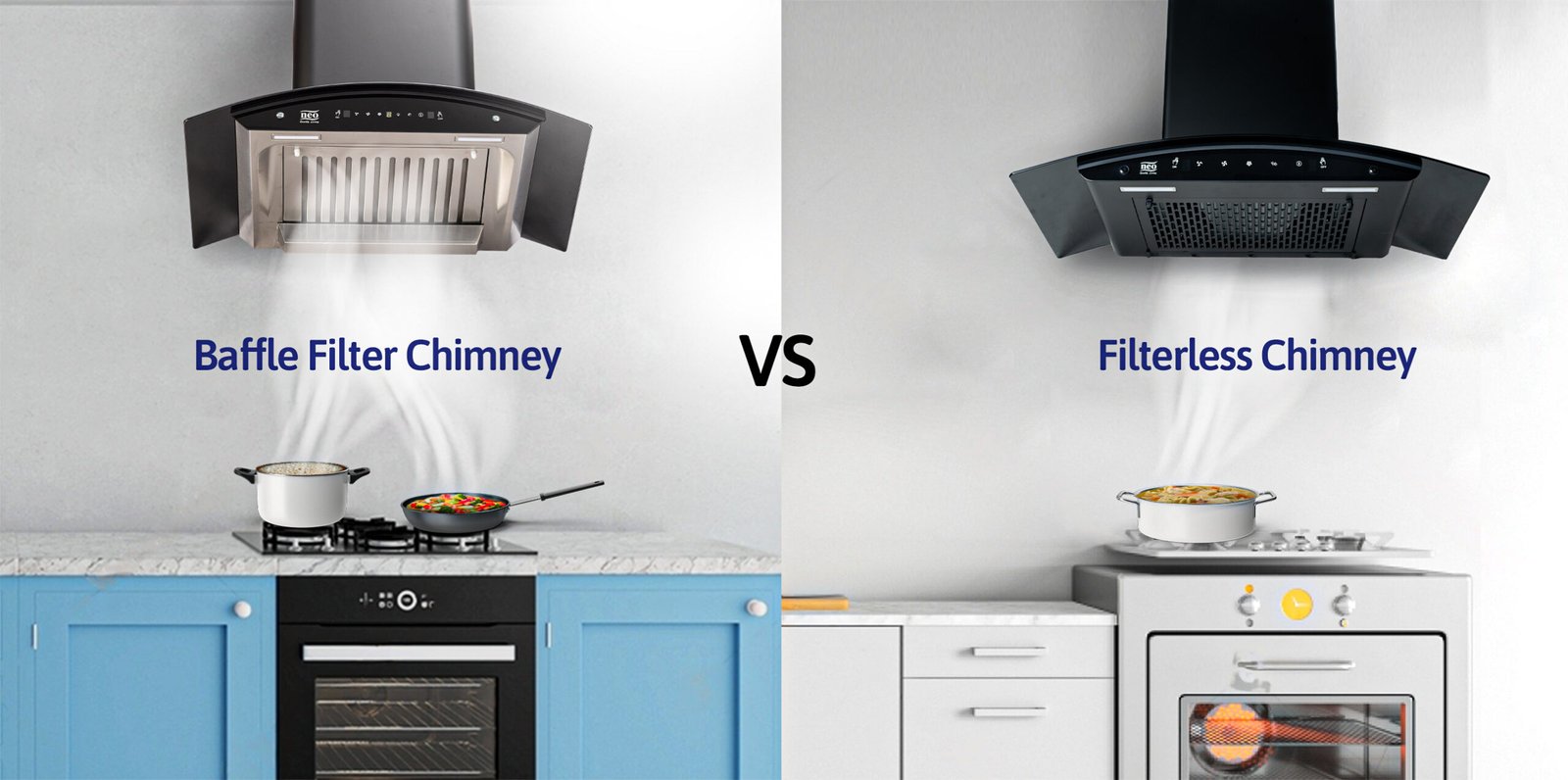
Preparing an authentic Indian meal involves high-heat tempering, generous amounts of mustard oil or ghee, and aromatic spices. While this produces delicious food, it also fills your kitchen with heavy smoke, vaporized oil, and airborne grease. Choosing the right kitchen chimney is essential to keep your kitchen walls, cabinets, and ceiling free from stubborn grime.
When searching for a kitchen chimney, the debate usually comes down to filterless vs baffle filter chimney designs. Both technologies claim to clear smoke effectively, but they tackle oil separation differently. This guide breaks down how each filter system works under intense cooking conditions, compares their performance, and helps you pick the right model for your home.
How Baffle Filters and Filterless Chimneys Handle Heavy Smoke
To pick the right chimney, you must first understand how airflow dynamics handle airborne grease during high-heat cooking like deep frying or making a heavy tadka.
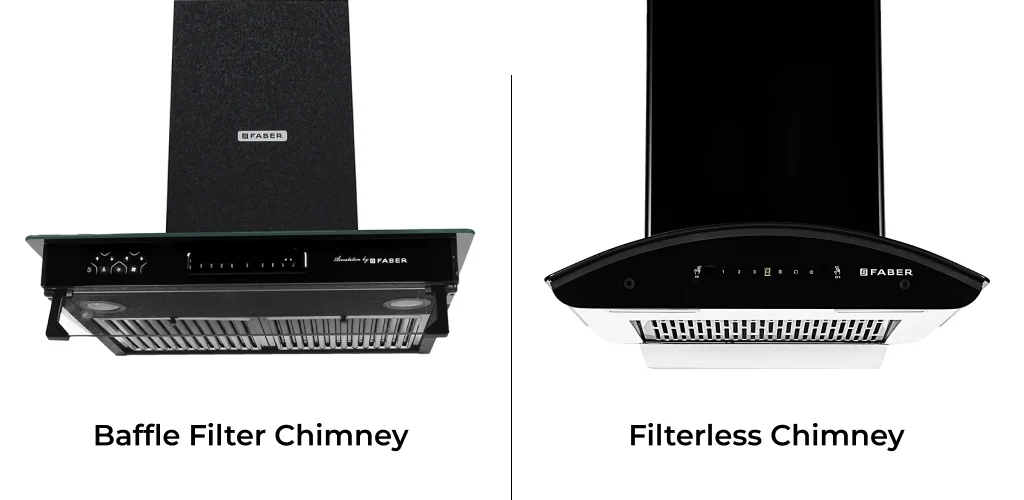
Baffle Filter Mechanics (The Cut-and-Splash Technique)
A baffle filter consists of multiple overlapping stainless steel or aluminum curves positioned at specific angles. When your chimney draws in smoke, the heavy, grease-laden air hits these curved steel plates.
This forces the air to suddenly change direction—a mechanism known as the “cut-and-splash” technique. Because oil droplets are heavier than air molecules, their inertia prevents them from turning quickly. The oil droplets slam into the metal surfaces, condense into liquid form, and drain down into an oil collector tray. The lighter smoke and hot air pass through the filter and vent outside your home.
How Filterless Auto-Clean Systems Work
A filterless chimney replaces the traditional mesh or steel baffle grill with a clear intake chamber and an internal oil separator.
Instead of trapping grease at the inlet face, a filterless system uses an impeller fan positioned directly behind an open grill to create immediate suction. The fan forces heavy oil droplets to sling outward against the inner housing walls through centrifugal force.
To clean this internal chamber, filterless chimneys rely on thermal auto-clean technology. With the push of a button, an internal heating element warms the housing walls to approximately 80°C–90°C. This melts viscous oil and grease buildup, allowing it to drip down into an external oil collector cup for easy removal.
Filterless vs Baffle Filter Chimney: Core Differences Compared
While both chimney types pull smoke out of your kitchen, their long-term durability, maintenance needs, and performance vary under daily use.
Grease Separation Efficiency During Heavy Frying & Tadka
Baffle filters physically block oil droplets right at the intake surface. Stainless steel baffles capture up to 80–90% of heavy grease before it ever reaches the motor assembly. This protects the internal blower motor from sticky oil buildup over time.
Filterless systems rely entirely on air velocity and centrifugal separation. While effective for light smoke and mild oil usage, continuous exposure to dense, vaporized mustard oil can leave micro-grease particles on the motor blades. Over several years of heavy frying, this extra weight can reduce motor efficiency if the auto-clean feature isn’t run regularly.
Suction Power Retainability and Motor Noise
As a baffle filter traps grease during a week of heavy cooking, the narrow air passages gradually fill with oil sludge. This constriction slows airflow and lowers effective suction power until you wash the filter.
Filterless chimneys do not have narrow filter gaps to clog up. Airflow remains unrestricted over time, allowing the chimney to maintain its maximum rated suction capacity (typically between 1,100 m³/hr and 1,500 m³/hr). Furthermore, because air doesn’t have to push through dense steel grates, filterless models generally run 2–4 dB quieter than baffle models operating at similar fan speeds.
Cleaning Maintenance & Physical Overhead
Maintaining a baffle filter requires manual labor. Every 3 to 4 weeks, you must remove the heavy steel filter panels and scrub them with hot water, caustic soda, or degreasing soap to dissolve caked-on grease.
Filterless auto-clean chimneys require far less manual effort. You simply press the “Auto-Clean” button once every 2 to 3 weeks. The heating cycle runs for 10 to 15 minutes, melting internal grease into the removable oil collector. You then detach the collector cup, wipe it clean, and snap it back into place.
| Performance Metric | Baffle Filter Chimney | Filterless Auto-Clean Chimney |
| Grease Trapping Method | Physical stainless steel curves | Centrifugal force & internal heater |
| Maintenance Effort | Manual scrubbing every 3–4 weeks | Touch-button auto-clean cycle |
| Suction Consistency | Drops as grease builds up on filter | Remains steady over extended use |
| Noise Level | Slightly higher due to air resistance | Moderately lower due to open airflow |
| Ideal Cooking Style | Heavy daily frying, deep roasting, tadka | Moderate frying, baking, low-oil meals |
| Motor Protection | High (grease blocked at intake) | Moderate (relies on auto-clean routine) |
Motor Tech Matters: BLDC vs Standard Motors in Chimneys
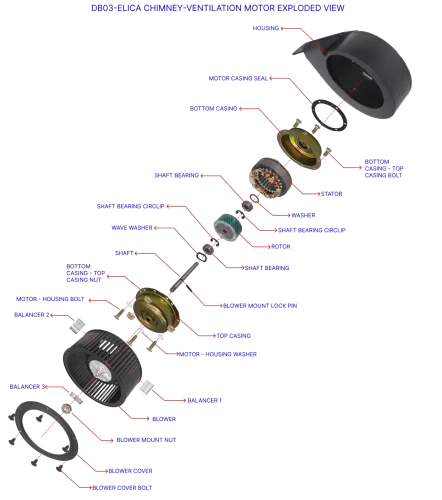
When choosing a kitchen chimney, motor technology is just as important as the filter type. Modern Indian kitchens are increasingly shifting toward Brushless Direct Current (BLDC) motors.
Why Variable-Speed BLDC Motors Complement Filterless Designs
Standard AC induction motors run at fixed speed steps and consume between 180W and 250W of power. In contrast, a modern BLDC motor kitchen chimney in India consumes up to 50% less electricity, operating efficiently between 70W and 120W.
BLDC motors provide precise variable speed control and higher torque output at lower RPMs. When paired with a filterless chimney, a BLDC motor dynamically adjusts its power output to keep suction constant, even if wind pressure creates backdraft inside your exhaust pipe.
Thermal Auto-Clean: Heating Element Efficiency
The reliability of a filterless chimney depends on its thermal heating element. Look for chimneys equipped with cast-alloy heating coils wrapped evenly around the motor housing.
Higher-grade thermal heating elements distribute heat uniformly, ensuring that all trapped grease melts into liquid without overheating internal electronics. Combining a BLDC motor with a reliable thermal heating element gives you a long-lasting, low-maintenance appliance.
Decision Matrix: Which Chimney Type Fits Your Cooking?
Every home has different cooking habits. Here is how to decide which option best fits your lifestyle and culinary routine, alongside other 5 must-have kitchen appliances for Indian homes that streamline daily domestic work.
Who Should Choose a Baffle Filter Chimney?
Choose a baffle filter chimney if:
- You cook heavy Indian meals daily involving deep frying (pooris, samosas), heavy ghee temperings, or non-vegetarian roasting.
- You prefer maximum long-term mechanical protection for the chimney motor.
- You do not mind scrubbing steel filter plates once or twice a month.
- Your kitchen experiences frequent power outages or low voltages that make touch-screen auto-clean systems impractical.
Who Should Choose a Filterless Auto-Clean Chimney?
Choose a filterless auto-clean chimney if:
- You want a hassle-free, low-maintenance appliance without manual filter scrubbing.
- Your cooking style uses moderate oil, steaming, baking, or light sautéing.
- You want quieter operation and consistent suction without sudden drops in airflow.
- You prefer modern features like gesture controls, motion sensors, and energy-efficient BLDC motors.
Key Specifications to Verify Before Purchasing
Before buying your new kitchen chimney, check these four critical specifications:
- Suction Capacity: For standard 2-burner or 3-burner stoves, aim for at least 1,100 m³/hr. For 4-burner hobs or kitchens with high oil usage, select 1,200 m³/hr to 1,500 m³/hr.
- Duct Pipe Material: Always insist on a flexible aluminum or rigid PVC duct pipe (preferably 6 inches in diameter). Avoid fragile foil/plastic ducts that tear easily and restrict airflow.
- Oil Collector Design: Ensure the oil collector tray is made of stainless steel or durable plastic and is easy to remove for cleaning.
- Warranty Coverage: Look for brands offering at least a 1 to 2-year comprehensive warranty on the chimney unit and a 5 to 10-year warranty on the motor assembly.
Much like reviewing capacity before picking up a double door refrigerator for your kitchen, matching chimney capacity and filter design to your daily needs ensures clean air and a grease-free home for years to come.
One Reply to “Filterless vs Baffle Filter Chimney : Which Should You Buy for Indian Cooking?”
[…] -have you checked Filterless vs Baffle Filter Chimney : Which Should You Buy for Indian Cooking? […]