
Every Indian kitchen needs a mixer grinder, but not every mixer grinder suits every kitchen. Walk into any appliance store and you’ll see dozens of models with different wattages, jar counts, and motor types — and most of the differences that actually matter never make it onto the box.
This mixer grinder buying guide breaks the decision down to the handful of specs that genuinely affect how the appliance performs in daily use: wattage, motor type, jars, and a few small usability details that spec sheets tend to bury. By the end, you should be able to shortlist models with confidence instead of guessing from marketing copy.
How to Decide What You Actually Need Before You Shop
Start by being honest about how you cook, not how you’d like to cook. If you grind dry spices and wet idli-dosa batter regularly, you need a mixer grinder built for daily, heavier use. If your needs are lighter — chutneys, purees, the occasional smoothie — a smaller, less powerful machine will do the job, and a personal blender might suit you even better.
It also helps to rule out the wrong appliance entirely. If you’re mainly after single-serve smoothies or protein shakes, a compact blender takes up less counter space and costs less. And if you want one machine to chop vegetables, knead atta, and whip cream in addition to grinding, that’s a food processor’s job — a mixer grinder isn’t designed for it, no matter how many jars it comes with.
This guide focuses specifically on mixer grinders for regular Indian cooking: dry masalas, wet batters, and the everyday grinding that happens several times a week.
Wattage: How Much Power Your Kitchen Actually Needs
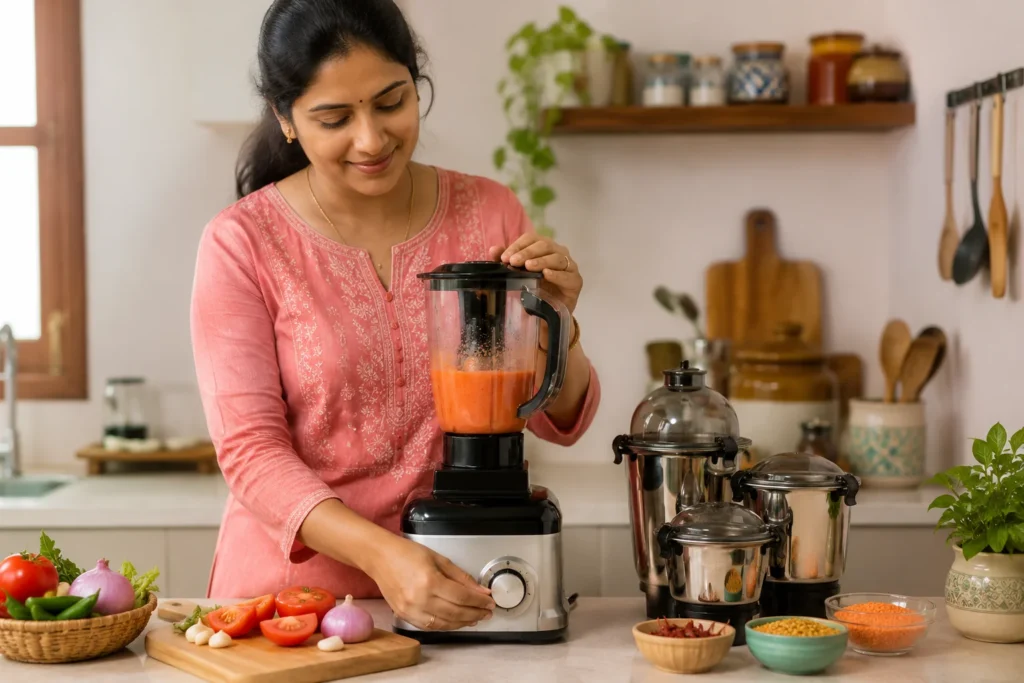
Wattage decides two things: whether the motor can handle heavy grinding without straining, and how long it can run continuously before it needs a break. Buying on price alone here tends to backfire within months.
500–600W: Light and Occasional Use
This band suits chutneys, dips, soft purees, and smoothies rather than daily dry-spice or batter grinding. Continuous run time is typically shorter, so it’s a reasonable choice only if your grinding needs are genuinely light.
750–1000W: The Standard for Most Indian Kitchens
For most households, this is the practical default. It comfortably handles dry masalas and wet batter for idli or dosa, and it can run for longer continuous stretches than lower-wattage motors — useful if you’re batch-grinding for the week.
1000W and Above: Heavy-Duty and Joint-Family Cooking
This tier suits large households, joint families, or anyone who batch-grinds masalas in bulk. The trade-off is noise — the most powerful motors also tend to be the loudest, so factor that in if your kitchen is open to the rest of the home.
BLDC vs. Conventional Motors: Is the Extra Cost Worth It?
Brushless DC (BLDC) motors are the biggest real innovation in this category in years. A lower-wattage BLDC motor can match the output of a higher-wattage conventional motor, which means lower running electricity and less heat build-up during long grinding sessions. Many BLDC models also bundle in extra safety and control features, like finer speed settings.
The catch is cost. BLDC mixer grinders carry a real price premium over an equivalent conventional model, and repairs on them tend to cost more too. They also aren’t dramatically quieter in everyday use, even though the motor itself runs more efficiently — and some users find them slightly less forceful than a strong conventional motor when grinding hard spices.
If lower running cost, finer speed control, and extra safety features matter more to you than upfront price, BLDC is worth the premium. If you grind hard spices often and want maximum raw power for the money, a well-rated conventional 750–1000W motor is the safer default.
Jars: Why More Isn’t Always Better
A mixer grinder that comes with five or six jars can look like better value, but most households only use two or three of them regularly. It’s worth thinking about jar size and purpose before jar count.
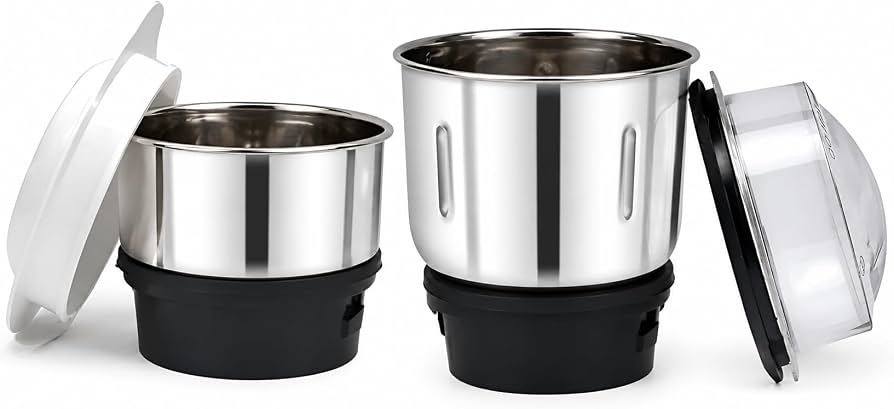
- Chutney jar — Usually the smallest jar. Match it to your household size: a smaller jar gives more even results for two or three people than grinding a small quantity in an oversized jar.
- Multipurpose jar — Handles dry spice grinding and medium-quantity jobs. This is the jar you’ll likely reach for most often.
- Wet grinding jar — Larger capacity, meant for idli-dosa batter or bulk wet grinding.
- Juicer jar — Often the least-used jar in the set. If you juice regularly, a dedicated cold-press juicer generally gives better yield and quality than a mixer grinder’s juicer attachment.
- Blender jar or chopper attachment — Occasionally bundled on select models. Useful only if you’d actually blend or chop at home rather than eat out or use a separate appliance.
Almost all grinding jars are stainless steel, which is the standard for durability and food safety. Add-on jars, like juicer or chopper attachments, are sometimes food-grade plastic instead. Rather than chasing the highest jar count, pick the combination that matches what you actually cook — it also means less clutter to store.
Everyday Usability Details That Matter More Than the Spec Sheet
A handful of small design choices affect daily use far more than an extra 100W ever will.
Controls: Round dials can be genuinely hard to turn with wet or oily hands unless they’re textured or grooved. Raised knobs, buttons, or touch panels are generally easier to operate mid-cook.
Overload protection is now standard across the category, so you don’t need to specifically shop for it — but it’s worth confirming it’s mentioned for any budget model you’re considering.
Jar detection (which stops the motor from starting unless a jar is seated correctly) and auto-restart prevention (which stops the mixer from switching back on by itself after a power cut) show up mostly on newer, often BLDC, models. Both are genuinely useful safety layers if you have young children at home or live somewhere with an unstable power supply.
Locking jars — a jar that clicks and locks in place — reduce the risk of spills during hands-free grinding and are a meaningful convenience upgrade if you’ve dealt with a leaking lid before.
Warranty, Certification, and Price Bands to Expect
Warranty coverage on mixer grinders commonly follows a pattern: one to two years on the product itself, often paired with a separately stated, longer warranty specifically on the motor. When comparing models, check both numbers rather than just the headline warranty period.
Every mixer grinder legally sold in India is required to carry BIS certification and the ISI mark under the safety standard covering domestic electric food mixers, and the government has been actively widening this requirement across household electrical appliances. It’s worth glancing for the ISI mark on the box before you buy, since it signals the product has been tested against India’s electrical safety standard. You can read more about how BIS certification works on the Bureau of Indian Standards’ official site.
On price, expect roughly three broad bands: budget entry-level models, a mainstream mid-range band for solid 750–1000W machines, and a premium band for BLDC and high-wattage heavy-duty models. Exact prices shift with sales and model updates, so treat any specific figure as a starting point for comparison rather than today’s final price — always check the current listing before you decide.
Mixer Grinder vs. Mini Chopper vs. Food Processor
It’s easy to assume a mini chopper or food processor can substitute for a mixer grinder, but they’re built for different jobs. As our guide to must-have kitchen appliances for Indian homes points out, a mini chopper handles small prep tasks like mincing garlic or onions well, but it won’t produce a smooth masala paste, chutney, or batter the way a proper mixer grinder does.
A food processor sits at the other end — useful if you also want to knead dough, whip cream, or handle larger chopping jobs, but usually overkill if grinding is your main need. If your kitchen already has a chopper or food processor and you’re wondering whether you still need a mixer grinder, the honest answer for most Indian households is yes: the two appliances complement each other rather than replace one another.
Service Network: The Factor Buyers Often Skip
Mixer grinder repairs are almost always handled at an authorised service centre rather than through a technician visiting your home. That makes local service availability a genuinely practical factor, not a minor detail — a great motor backed by a distant or unresponsive service network can turn a small repair into a weeks-long hassle.
Before you commit to a brand, it’s worth doing a quick search for its service centre presence in your city or nearby towns, particularly if you live outside a major metro. Service quality and coverage vary noticeably between brands and between regions for the same brand, so don’t assume a well-known name automatically means convenient local support.
Who Should Consider Upgrading Their Mixer Grinder
Not everyone needs to replace a working mixer grinder, but a few situations make an upgrade worthwhile:
- You regularly make South Indian batters or bulk-grind masalas and your current motor struggles or overheats
- Your household has grown, and your existing jars are consistently too small
- You’re dealing with a low-wattage model bought mainly for its price and outgrew it quickly
- You want the safety features (jar detection, auto-restart prevention) that older mixer grinders typically don’t have
Common Mixer Grinder Buying Mistakes to Avoid
- Buying on price alone. A cheap 500W model bought to save money often gets replaced within a year once daily grinding needs outgrow it.
- Ignoring jar size for your household. A large wet-grinding jar isn’t useful if you’re regularly grinding small quantities for one or two people.
- Skipping the service-network check. A great motor is only as good as the support behind it if something goes wrong.
- Paying for a juicer jar you’ll rarely use well. A dedicated juicer will usually outperform it if juicing is a regular habit rather than an occasional extra.
Frequently Asked Questions
Is 500W enough for Indian cooking? It’s enough for light, occasional use — chutneys, purees, smoothies — but most households doing regular dry-spice and wet-batter grinding are better served by 750W or above.
Is a BLDC mixer grinder better than a conventional one? It depends on what you’re optimising for. BLDC motors run more efficiently and often add safety features, but they cost more upfront and to repair. A strong conventional 750–1000W motor remains a solid, cost-effective default for most kitchens.
How many jars do I actually need? Most households regularly use two: a chutney jar sized to their family and a multipurpose or wet-grinding jar. Extra jars, especially the juicer jar, often go unused.
Is a mixer grinder the same as a food processor? No. A mixer grinder is built for grinding and wet/dry blending; a food processor adds functions like dough kneading, chopping, and whipping that a mixer grinder isn’t designed to handle well.
Final Buying Checklist
- Matched wattage (500–600W, 750–1000W, or 1000W+) to your actual cooking frequency
- Decided whether BLDC’s efficiency and features are worth the price premium for you
- Checked jar sizes and count against your household size and cooking habits
- Confirmed the control type (knob, button, or touch) suits wet-hand use
- Verified the warranty period on both the product and the motor
- Looked for the BIS/ISI mark on the box
- Checked service centre availability in your city before finalising a brand
One Reply to “Mixer Grinder Buying Guide for Indian Kitchens 2026”
[…] you’re setting up a full Indian kitchen rather than a single appliance, our mixer grinder buying guide and induction cooktop guide cover two other appliances most kitchens sort out around the same time. […]