Delhi’s winter smog alerts. Bengaluru’s traffic haze. Mumbai’s monsoon mould spores. Indian air quality problems change shape by city and season, but the buyer’s question stays the same: does your home actually need an air purifier, and if it does, which one is worth the money? This air purifier buying guide skips the marketing language and walks through the factors that genuinely decide performance, so you can match a machine to your room, your budget, and your actual air quality problem — not just the loudest ad you saw last week.
Why Air Purifiers Are Becoming Essential in Indian Homes
Outdoor pollution is the obvious trigger. Several Indian cities regularly report “poor” to “severe” readings on the national Air Quality Index during winter, and that outdoor air finds its way indoors every time a door or window opens. But indoor sources matter just as much: cooking smoke, incense, dust from construction-heavy neighbourhoods, and monsoon humidity that encourages mould spores in coastal and high-rainfall regions.
None of this means every home needs a purifier immediately. It means the decision should be based on your specific exposure, not a generic “everyone needs one” pitch.
Do You Actually Need One?
Signs your air quality needs attention
Frequent throat irritation, a family member with allergies or asthma, visible dust settling within hours of cleaning, or living near a busy road or construction site are all practical signals worth taking seriously.
When you can reasonably hold off
If you live in a well-ventilated home away from major traffic corridors, rarely notice dust or odour buildup, and have no one in the household with respiratory sensitivity, a purifier is a nice-to-have rather than urgent. Good cross-ventilation and regular cleaning may cover your needs for now.
How to Actually Compare Air Purifiers
Specs sheets are full of numbers designed to look impressive. Here’s what actually separates a good purifier from an average one.
Understand CADR Before Anything Else
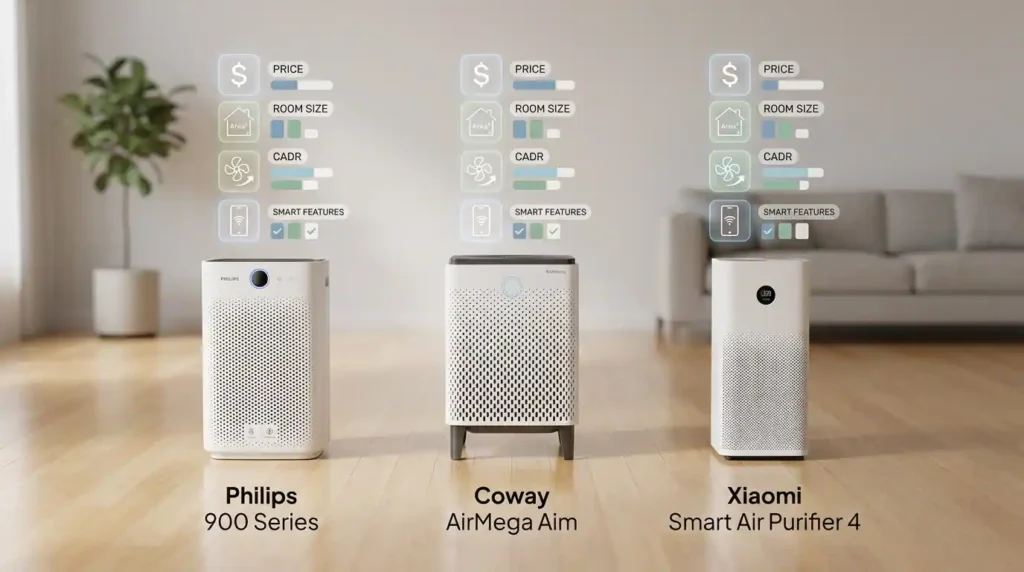
CADR (Clean Air Delivery Rate) tells you how much filtered air a purifier pushes out per hour — the higher the number, the faster it can clean a given space. Treat CADR as your primary comparison metric. Be cautious of the “room coverage” figures brands print on the box; different manufacturers calculate these differently, so two purifiers claiming the same room size can perform very differently in practice. When comparing models, look for a published CADR rating rather than relying on box copy alone.
Filtration Stages and HEPA Grade
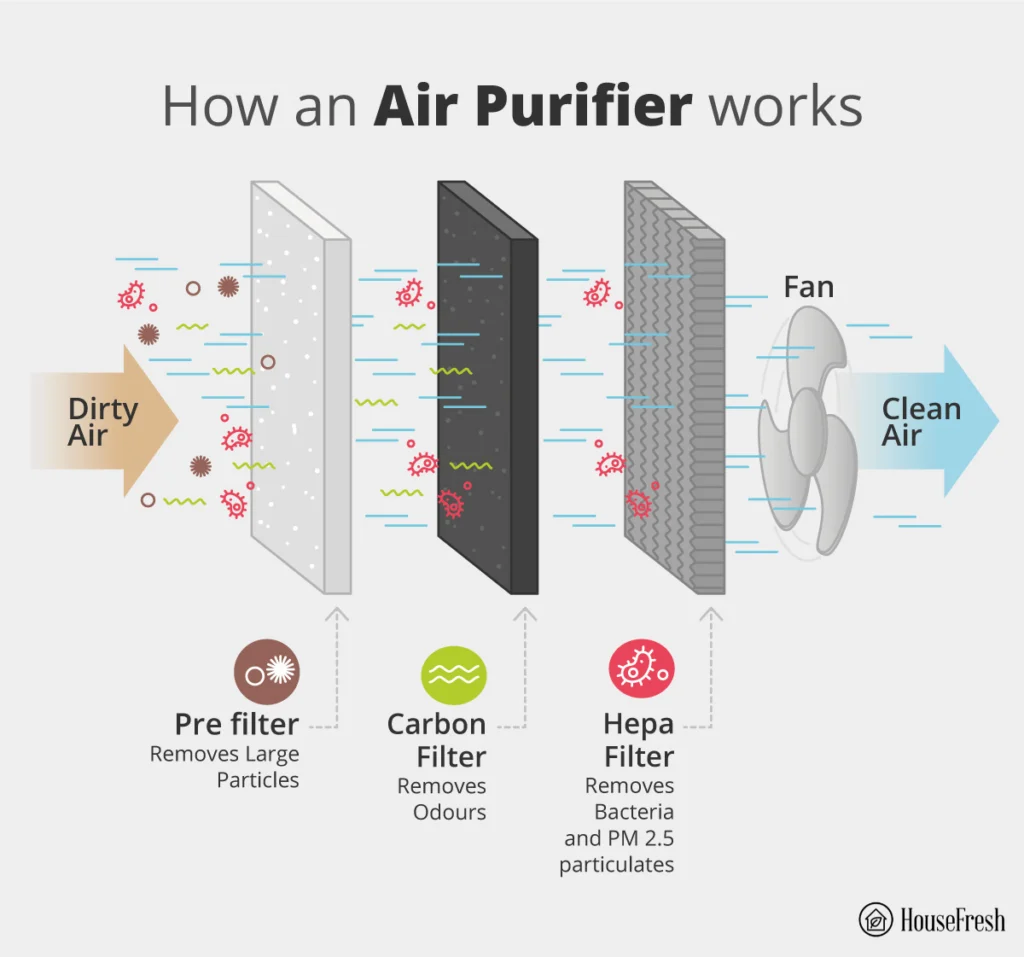
Most purifiers use a multi-stage setup: a pre-filter for large particles, a HEPA filter for fine particulate matter, and often an activated carbon layer for odours and gases. A true HEPA filter (ideally H13 grade) matters more in Indian conditions than in low-dust climates, simply because of the volume of coarse dust most homes deal with daily. More filtration stages generally mean better handling of both large dust and fine pollutants, but they can also mean higher running costs — which brings us to the next factor.
Running Cost, Not Just Purchase Price
The upfront price is only part of the equation. Filters need periodic replacement, and costs vary widely — anywhere from a few hundred rupees to several thousand, depending on the filter type and how often it needs changing. Before buying, check the manufacturer’s stated filter life and replacement price, and factor that into your real annual cost.
Smart Features Worth Paying For
Auto mode (where the purifier senses air quality and adjusts fan speed itself), app-based monitoring, and voice assistant support are genuinely convenient — you can set it and forget it rather than manually adjusting settings. These features add cost, though, so weigh them against how much you’ll actually use them.
Air Quality Display: Numbers vs Colour Indicators
Some purifiers show an actual PM2.5 number; others use a simple colour-coded light. A numeric display gives you a clearer, more specific read on your room’s air quality at any given moment, which is useful if you want to track improvement over time rather than just get a rough “good or bad” signal.
What You Get at Each Budget Tier
| Budget | What to Realistically Expect |
|---|---|
| Under ₹10,000 | Compact coverage, basic 2–3 stage filtration, often no true HEPA H13, minimal smart features |
| ₹10,000–₹15,000 | True HEPA filtration, decent CADR for small-to-medium rooms, some models add app control or auto-sensing |
| Above ₹15,000 | Larger room coverage, multi-stage filtration with carbon layers, stronger smart-home integration, generally lower per-hour running noise |
Treat this as a general guide rather than a guarantee — always confirm the specific CADR and filter type for the exact model you’re considering, since features vary between brands even within the same price band.
Common Mistakes Buyers Make
- Trusting advertised room size over CADR. Room-coverage claims aren’t standardised across brands; CADR is the more reliable comparison point.
- Ignoring filter replacement cost. A cheaper purifier with expensive, frequently-replaced filters can cost more over two years than a pricier model with a longer-lasting filter.
- Buying based on purchase price alone, without checking whether the CADR actually suits your room size — an undersized purifier in a large room will run constantly and still underperform.
- Assuming any purifier removes cooking odours. Odour and gas removal specifically needs an activated carbon layer; a HEPA-only filter mainly handles particulate matter, not smells.
Who Should Buy vs Who Should Avoid
Buy one if: you live in a high-pollution city, have pets, have a household member with allergies or asthma, or live near construction or a busy road.
Hold off if: you’re in a well-ventilated, low-pollution area with no health sensitivities in the household — your money may be better spent on improving ventilation or investing in good exhaust and cleaning habits first.
If you’re weighing a purifier against a cooling upgrade, it’s also worth knowing that some air conditioners now include built-in filtration — our split AC buying guide covers what those filters can and can’t do compared to a dedicated purifier.
Maintenance Tips to Keep It Effective
Place the purifier centrally in the room rather than tucked into a corner — airflow matters more than most buyers expect. Keep windows and doors closed while it’s running, since open windows constantly reintroduce outdoor pollutants. Replace filters on the manufacturer’s recommended schedule rather than waiting for visible dirt; HEPA filters lose efficiency gradually, often before they look obviously dirty. If dust is a bigger issue in your home than airborne allergens specifically, pairing regular vacuuming — see our robot vacuum buying guide if you want a low-effort option — with your purifier will do more for overall air quality than the purifier alone.
Festive and end-of-season sales are also a reasonable time to buy, since appliance discounts are common during these windows — our appliance sale-season checklist has tips on spotting a genuine deal versus an inflated “before” price.
FAQs
What is a good CADR for a bedroom? For a typical Indian bedroom (roughly 120–150 sq ft), a CADR in the 200–350 m³/h range is generally sufficient, but always check it against the specific room size the manufacturer used to calculate that figure.
Does an air purifier remove cooking smells? Only if it includes an activated carbon layer. A HEPA-only filter is built for particulate matter, not gases or odours.
Is HEPA H13 necessary for home use? It’s not strictly mandatory, but it captures a higher percentage of fine particles than lower HEPA grades, which is useful given how dust-heavy most Indian environments are.
Can one purifier cover an entire flat? Generally no. Most home purifiers are designed for single-room coverage; larger homes typically need either a higher-CADR unit for open-plan spaces or multiple purifiers for separate rooms.